You Shouldn't Need a Medical Degree to Understand Your Own Care
There's a quiet expectation baked into modern healthcare:
That patients and caregivers will somehow translate clinical language, fragmented records, and disconnected portals into clarity—on their own.
We're told to “be proactive.”
To “advocate for ourselves.”
To “manage our care.”
But most people are being asked to do this inside systems that were never designed for them.
Medical history still lives in silos—spread across hospital portals, PDFs, lab systems, insurance dashboards, and specialist offices. Even when access technically exists, understanding rarely does. And for caregivers juggling multiple family members, the burden multiplies fast.
You shouldn't need clinical training to answer basic questions about your own health.
You shouldn't need to decode medical jargon, reconcile conflicting records, or remember which portal holds which piece of your story— especially during moments of stress, urgency, or change.
For many families, this isn't a rare experience. It's a predictable outcome of a healthcare system where medical history lives in too many places, across too many portals, in formats that weren't designed for everyday people — especially caregivers.
Even though most people now have online access to their health records, a sizable share still doesn't use it.
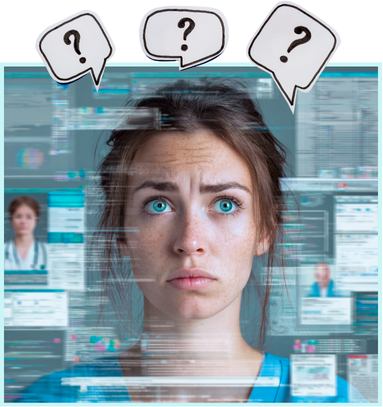
Did You Know?
Nearly 3 in 4 U.S. patients say they have online access to their medical records—yet many still struggle to understand what they're seeing.
Access alone doesn't equal clarity. Most records are written for clinicians, not patients, leaving families to interpret complex data without context.
Source: U.S. Office of the National Coordinator for Health IT (ONC)
Access Isn't the Same as Understanding
Healthcare often points to “access” as the finish line.
But access without clarity isn't empowerment—it's friction.
A lab result without context.
A medication list without history.
A visit summary buried three logins deep.
These fragments don't help patients make better decisions.
They create hesitation, confusion, and anxiety—particularly for caregivers managing care on behalf of others.
In practice, families are doing unpaid systems work for healthcare infrastructure that hasn't caught up with how people actually live, move, and care for one another.
That's not a technology problem alone.
It's a design problem.
And increasingly, it's a rights issue.
Medical records weren't designed for everyday people—but that doesn't mean you can't take control of them.
Access Docsnap's “Simple Guide to Understanding Your Medical Records” to comprehend better what you’re seeing, ask more thoughtful questions, and feel more confident navigating fragmented portals and appointments.

The Case for a Patient Data Bill of Rights
If healthcare is serious about patient-centered care, then clarity must be treated as a right—not a bonus feature.
A modern Patient Data Bill of Rights starts with a simple premise:
People deserve to own, access, understand, and securely share their medical information—without added complexity or gatekeeping.
That means:
- Medical history should follow the patient, not the institution
- Information should be readable by real people, not just clinicians
- Caregivers should be able to support loved ones without friction
- Data should be portable, transparent, and usable when it matters most
This isn't about replacing clinicians or simplifying medicine itself. It's about respecting the reality that patients are now active participants in their care—and need systems that reflect that role.
As modern healthcare evolves, taking a more proactive role in your own care or that of your family needs to account for the infrastructure that supports them as they take ownership.
Across multiple studies, 75% of research shows that patient access to electronic health records improves understanding, awareness, and engagement in care.
When people can review their health information clearly, they're better prepared for conversations, decisions, and next steps. Source: Systematic review of patient access to EHRs
Why This Moment Matters
Each January, families reassess healthcare decisions.
Insurance changes.
New providers.
Caregiving responsibilities shift.
Kids returning to school—or coming home with new needs (and new illnesses).
Parents age into more complex care.
At the same time, healthcare systems are undergoing their own reset—driven by interoperability mandates, data standards, and renewed attention to patient access.
What's missing is the connective tissue between technical progress and everyday usability.
Standards matter—interoperability matters. But they only deliver value when they result in something patients can actually understand and use.
That gap—between what's technically possible and what's humanly accessible—is where trust is built or lost.
Healthcare Doesn't Need More Portals
It Needs Clarity. The next era of healthcare won't be defined by who stores the most data—but by who makes it usable.
Clarity reduces errors.
Clarity saves time.
Clarity lowers stress for caregivers.
Clarity enables better conversations between patients and providers.

Errors Are More Common Than Most Patients Realize
A recent survey found that almost 61% of Gen Z and 52% of Millennials have had to correct a mistake in their records, compared to only 32.5% of older generations.
Clarity and transparency help patients catch mistakes before they become problems.
Source: Patient Safety and Quality Healthcare
Clarity restores a sense of agency in moments when people feel most vulnerable.
This is the direction healthcare must move to serve patients, not just systems.
A Shift Toward Patient-First Data
At Docsnap, this belief has shaped how we think about the future of medical records: not as static files but as living, human-centered narratives that belong to the people they describe.
As we look ahead to the new year, one thing is clear: Patients shouldn’t have to become experts in healthcare infrastructure to participate in their own care. Understanding your medical history shouldn’t require a medical degree. And access, without clarity, isn’t enough.
Something better is on its way —grounded in the idea that health data should work for people, not the other way around.